
DFR vs. Traditional Police Drone Programs: Cost, Staffing and Response Time Compared

Skydio imagery.
By John Henry, Chairman & CEO of Grace3 Technologies
Public safety leaders often face this exact decision: keep building a traditional tactical drone program, move to Drone as First Responder (DFR), or operate both.
I do not see these as competing programs. They are different operating models. A traditional program develops pilot skill, community trust, and operational evidence. DFR changes where the pilot works and when the aircraft can launch. For many agencies, the strongest path is sequencing, not replacement.
For context, see the program overview in this series.
Legal note: This article provides general operational information, not legal advice; procurement, FAA and privacy requirements vary by jurisdiction; agencies should consult qualified legal and aviation professionals.
What a Traditional Police Drone Program Actually Costs to Run
A traditional police drone program often deploys a trained pilot to a specific scene or planned operation. The aircraft may be launched by hand, and the team works from the ground near the incident. This approach can serve tactical operations, searches, traffic incidents, and crime-scene documentation.
The staffing draw matters. A conventional deployment can tie up roughly four officers: a pilot, cover officer, action officer, and second cover officer. The actual requirement varies by mission and agency procedures, but the operational effect is clear: those people may be unavailable for other field work while the drone team is deployed.
The purchase price is only one part of the program. The CNA September 2025 white paper, Drones as First Responders, citing Grepow (2024), reports that initial costs for drones and specialized equipment range from $1,000 to $30,000. CNA also describes one agency’s published five-year report: 25 drones, with initial costs of $114,811 and maintenance costs of $48,800 over five years.
CNA identifies other program costs as well: developing policies, training pilots and patrol members, conducting audits, and, for established programs, supporting air traffic management systems and takeoff and landing infrastructure. A complete budget therefore includes the people and processes needed to operate responsibly, not just the aircraft.
Traditional programs also create skills and practical evidence about what works locally. That experience can inform later decisions about coverage, policy, training, and which missions are appropriate for DFR. For crime-scene documentation and evidence workflows, see Your Drone Footage Is Now Evidence: How DFR Video Holds Up in Court.
What DFR Adds and What It Removes
DFR connects aircraft staged at strategic locations with remote pilots, dispatch processes, communications, and live video. A pilot can launch from a dock or other approved site and operate from a remote location. The aircraft can provide aerial information while ground units are still responding.
That changes the work, but does not eliminate it. DFR can reduce the need to send a pilot and support personnel to every incident. It adds ongoing demands for remote pilot coverage, software, connectivity, infrastructure, maintenance, training, and governance.
| Operating factor | Traditional program | DFR program |
|---|---|---|
| Where the pilot sits | Near the scene or at a field deployment location | At a remote operations or command location |
| Launch and recovery | Hand-launched and recovered by the team | Managed through a dock or designated launch site |
| Line of sight | Typically operated with the pilot near the aircraft | May use remote operations where authorized |
| Mission types | Tactical, planned, and on-scene support | Dispatch-linked response to qualifying calls |
| Staffing draw on the field | Officers join the deployment at the incident | Remote operation can preserve field personnel |
| Response trigger | A team or supervisor requests a drone response | A defined call or event triggers a launch |
| What it costs to run | Aircraft, training, personnel, maintenance, and data handling | Those costs plus docks, software, connectivity, and remote coverage |
The Staffing Equation Is the Real Decision
DFR moves staffing from field deployment toward remote, sustained operations. It does not make the pilot role disappear. A pilot must monitor and manage the mission, and the agency needs a plan for concurrent calls, handoffs, incident duration, training, and coverage.
In a Police1 article on DFR costs, Lt. Nate Lange notes that multiple docks can require multiple pilots, especially when simultaneous launches are part of the plan. He identifies staffing as one of the most significant challenges. Lange recommends Part 107 certification and at least 10 hours of pilot training per month.
Aircraft endurance and incident duration also affect workload. In Skydio’s study of 1,779 DFR flights, conducted in Skydio DFR Command between September 15 and November 14, 2024, Skydio reports that average flight time was between 30 and 40 minutes, based on battery life and flight conditions. Skydio found that an average of 17% of calls for service required more than one drone flight, and 28% of all flights were relief flights for an aircraft already on scene.
That means a simple launch count can understate staffing and aircraft needs. Longer incidents may consume more pilot hours, require a relief aircraft, and demand careful coordination to maintain coverage. Skydio also reports that, among agencies with 24/7 operations in its study, 58% of flights took place overnight, between 8 p.m. and 8 a.m. Agencies evaluating around-the-clock service should plan for the hours when their own call patterns and staffing needs are greatest.
Response Time: What Changes and What Does Not
In the planning frame used in this series, DFR programs are designed to reach an incident in approximately two minutes or less in suitable coverage areas, compared with a priority ground response that may take seven to nine minutes. These are planning figures, not guarantees. Actual performance varies by agency, dock placement, weather, connectivity, airspace, aircraft type, and dispatch procedures.
The important difference is aerial awareness, not replacement of a ground response. An early view can help personnel understand what is happening, identify hazards, and adjust the response before officers arrive. DFR does not mean every call is resolved by a drone, nor does it remove the need for officers to make informed decisions on the ground.
The Federal Aviation Administration’s public safety resources and Part 107 waiver guidance are useful starting points for understanding operational requirements. An agency’s flight procedures and permissions should match its planned operations.
Buy or Lease, and What Each Commits You To
Ownership gives an agency direct control over equipment and refresh decisions. It also puts maintenance, repairs, spare aircraft, parts, and contingency planning on the agency’s budget. Leasing may bundle some costs and make annual planning more predictable, depending on the provider and agreement. It is important to compare what each option includes and which responsibilities remain with the agency.
Lange reports that his agency budgeted a few hundred thousand dollars annually for its DFR platform before contracting. That is an example from one agency’s planning, not a general price benchmark. Total cost depends on coverage, staffing, software, connectivity, aircraft and dock configuration, and service scope.
Whichever purchasing model is selected, CAD integration and dependable connectivity belong in the evaluation. Dispatch-linked workflows can help pilots receive the information they need without unnecessary steps. A transparency page that publishes flight data can also support community understanding and confidence, as Lange notes in his Police1 article.
For additional context on budget paths and funding considerations, see DFR Program Funding: Grants and Budget Paths for Police and Fire Agencies.
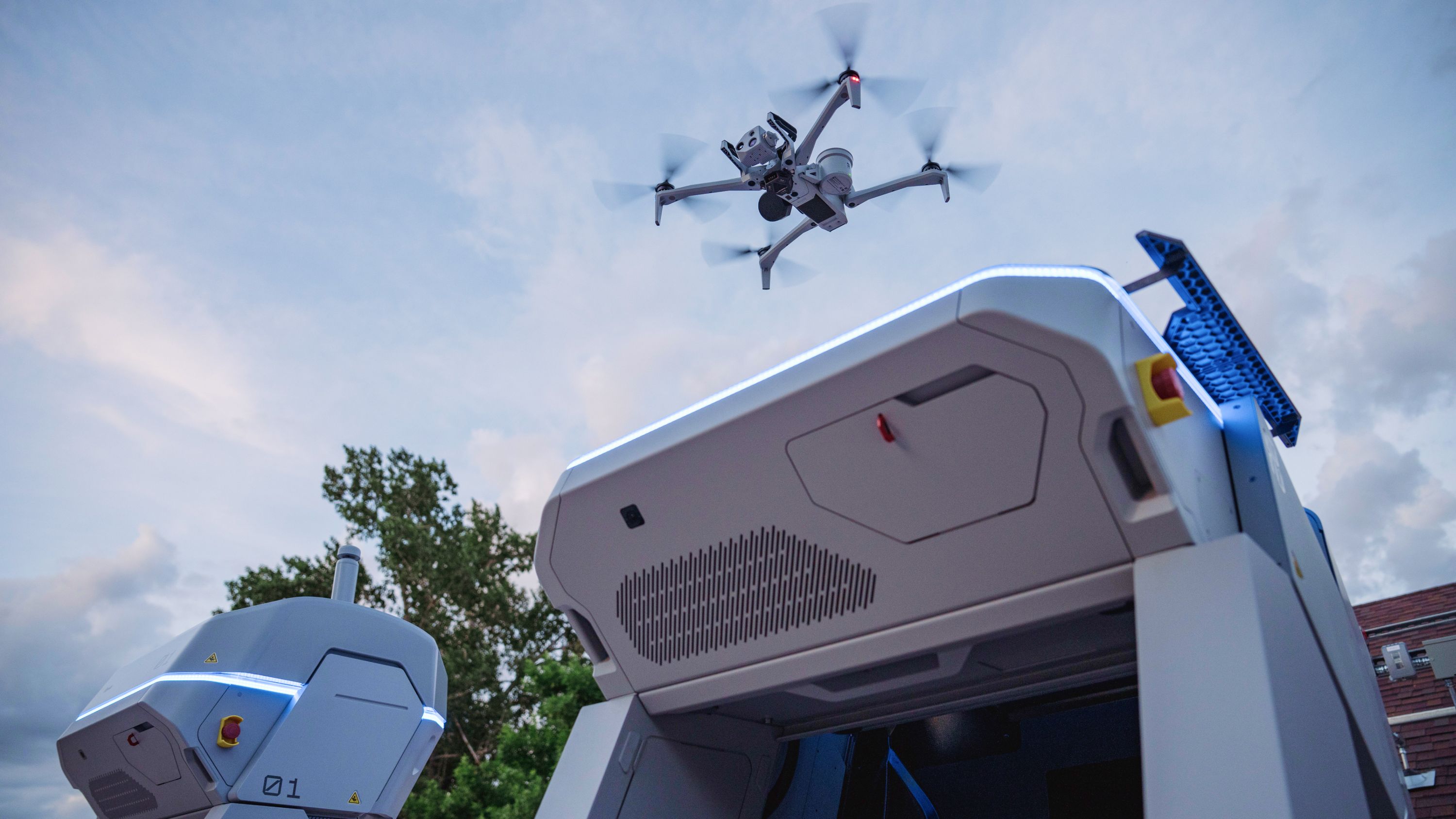
Skydio imagery.
Which Model Fits Which Agency
A traditional program may fit an agency building its first UAS capability, developing pilot proficiency, or supporting planned and specialized missions. It can also work where call patterns, staffing, geography, or available resources do not yet support a sustained remote-response model.
DFR may fit an agency with recurring calls where early aerial information can improve assessment, established dispatch processes, suitable launch locations, reliable connectivity, and a sustainable remote staffing plan.
Some agencies will benefit from both. Traditional teams can retain specialized deployments and on-scene expertise, while DFR supports qualifying calls where early awareness is valuable. The right model follows the mission and the agency’s ability to sustain it.
How to Sequence the Two Models
A measured sequence can reduce risk and strengthen the budget case:
- Build the foundation. Establish policy, training, mission criteria, data handling, and community communication through a traditional program.
- Document operational needs. Track mission types, response gaps, field staffing demands, and the conditions where earlier aerial information could matter.
- Design a focused DFR phase. Assess dock locations, connectivity, dispatch integration, pilot coverage, compliance, maintenance, and performance measures.
- Expand against evidence. Use the results and operating experience to determine whether to add coverage, extend operating hours, or retain the two models side by side.
This sequence turns experience into a scaling plan. For a deeper look at the legal side, see BVLOS for Public Safety: Beyond Visual Line of Sight Drone Rules, Waivers and Part 108 for Your DFR Program. For how the operating model connects to command-center integration, see Real-Time Crime Centers and Situational Awareness: Where DFR Fits.
The Procurement Path
At Grace3 Technologies, we support public safety leaders and technology partners as they connect operational requirements with technology and an executable procurement path. We are an authorized Skydio reseller. Our solutions include autonomy and robotics, public safety, geospatial situational awareness, connectivity, cybersecurity, and related infrastructure. We maintain 15 contract vehicles to support public sector purchasing.
A considered comparison should account for the full operating model: field staffing, remote pilot coverage, aircraft and docks, connectivity, software, training, maintenance, and community trust. We help agencies organize those requirements and move toward a solution designed around their mission.
Request a quote for a compliant quote in 45 minutes or less for qualified requests.